All Issue

2020 Vol.13, Issue 4 Preview Page

Original Article

31 December 2020. pp. 47-63
Abstract
References
1
Bak, H. J. (2012). Public Perceptions of the Risk of BSE and the Risk-Avoidance Behavior in Korea. The Journal of Rural Society 22(1): 311-341.
2
Bodenhausen, G. V. (1993). Emotions, Arousal, and Stereotypic Judgments: A Heuristic Model of Affect and Stereotyping. In D.M. Mackie & D.L. 10.1016/B978-0-08-088579-7.50006-5
3
Brehm, J. and Rahn, W. (1997). Individual-level Evidence for the Causes and Consequences of Social Capital. American Journal of Political Science. 41(3): 999-1023. 10.2307/2111684
4
Cha, Y. J. (2012). Risk Perception Model and Nuclear Risk: Test and Application of Psychometric Paradigm. Korean Policy Studies Review. 21(1): 285-312.
5
Choi, H. J. (2017). Research of Risk Communication Strategy for the Enhancement of Environmental Risk Perception and Eco-friendly Behavioral Intention: Application of Construal-Level Theory on Global Warming and Particulate Matter Risk Message. Doctoral Dissertation. Graduate School of Sungkyunkwan University.
6
Choi, J. S. (2009). A Study on the Social Amplification Factors Of Risk Perception. Korean Policy Sciences Review. 13(3): 165-188.
7
Chung, I. J. (2014). A Study on Risk Perception and Policy Implication : A Psychometric Analysis of Korean Perception for Technological Risks. Journal of the Korean Society of Safety. 29(1): 80-85. 10.14346/JKOSOS.2014.29.1.080
8
Chung, I. J. (2018). A Study on Mass Media and Risk Perception: Application of Facilitated Group Modeling to Social Risks. Journal of the Korean Society of Safety. 33(2): 124-131.
9
Earle, T. C. (2010). Trust in Risk Management: A Model-based Review of Empirical Research. Risk Analysis: An International Journal. 30(4): 541-574. 10.4324/9781849776592
10
Fukuyama, F. (1995). Trust: The Social Virtues and the Creation of Prosperity (Vol. 99). New York, NY: Free press.
11
Heo, S. Y. and Yoon, S. W. (2013). Analysis of Consumer's Risk Perception about Food Safety through the Analytic Lens of Psychometric Paradigm. Korean Journal of Food Marketing Economics. 30(2): 97-116.
12
Hetherington, M. J. (1998). The Political Relevance of Political Trust. American Political Science Review. 92(4): 791-808. 10.2307/2586304
13
Huang, L., Han, Y., Zhou, Y., Gutscher, H., and Bi, J. (2013). How do the Chinese Perceive Ecological Risk in Freshwater Lakes? PLoS ONE, 8(5): e62486. 10.1371/journal.pone.006248623671602PMC3650014
14
Jeong, J. Y. and Kim, S. Y. (2014). Exploratory Analysis of the Multidimensionality of Trust and Nuclear Acceptance. Korean Public Administration Review. 48(4): 51-78.
15
Kim, W. S. (2011). An Analysis of Factors Influencing Trust in Government : A Test of Cultural and Institutional Performance Approach, Social Science Research Review, 27(2): 141-161.
16
Kim, Y. J. (2017). The Effects of Trust In Government, Disaster Experience, and Social Capital on Disaster Risk Perception : Focusing on Disaster Victims in Local Areas. Doctoral dissertation, Graduate School of Yonsei University.
17
Knight, A. J. and Warland, R. (2005). Determinants of Food Safety Risks: A Multi-disciplinary Approach. Rural Sociology. 70(2): 253-275. 10.1526/0036011054776389
18
Kunreuther, H., Easterling, D., Desvousges, W., and Slovic, P. (1990). Public Attitudes Toward Siting a High-level Nuclear Waste Repository in Nevada. Risk analysis. 10(4): 469-484. 10.1111/j.1539-6924.1990.tb00533.x
19
Lee, D. K. and Min, Y. K. (2016). An Exploratory Study on Salience of Policy Failure in Large-Scale Disaster : Focused on Analysis on the News of Natural Social Disaster. The Korean Journal of Local Government Studies 19(4): 119-142.
20
Lee, S. Y. (2015). Psychological Approaches and Suggestions about the Risks of Korea : Focusing on the Sewolho Ferry Disaster. The Korean Journal of Psychology: General. 34(3): 709-739. 10.22257/kjp.2015.09.34.3.709
21
Lerner, J. S. and Keltner, D. (2000). Beyond Valence: Toward a Model of Emotion-specific Influences on Judgment and Choice. Cognition and Emotion. 14 (4): 473-493. 10.1080/026999300402763
22
Nye, J. S., Zelikow, P. D., and King, D. C. (1997). Why People Don't Trust Government. Cambridge, MA: Harvard University Press.
23
O'Toole, M. (2002). The Relationship between Employees' Perception of Safety and Organizational Culture. Journal of Safety Research. 33: 231-243. 10.1016/S0022-4375(02)00014-2
24
Park, H. B. and Lee, H. C. (2007). A Study on the Effects of Family Social Capital to Interpersonal, Civil Society, and Government Trust. Korean Public Administration Quarterly. 19(4): 1171-1198.
25
Park, J. H. (2008). Government Trust and Policy Support: The Case of National Electronic ID Policy, Korean Journal of Public Administration. 46(1): 93-122.
26
Park, S.A (2006). The Relationship between Understanding of Government and Trust in Government. Korean Public Administration Review, 40(21): 73-97.
27
Putnam, R. D., Leonardi, R., and Nanetti, R. Y. (1994). Making Democracy Work: Civic Traditions in Modern Italy. Princeton University Press. 10.1515/9781400820740
28
Renn, O. (2008). White paper on risk governance: Toward an integrative framework. In Global Risk Governance (pp. 3-73). Dordrecht: Springer. 10.1007/978-1-4020-6799-0_1PMC7120941
29
Scolobig, A., De Marchi, B., and Borga, M. (2012). The Missing Link between Flood Risk Awareness and Preparedness: Findings from Case Studies in an Alpine Region. Natural Hazards. 63(2): 499-520. 10.1007/s11069-012-0161-1
30
Siegrist, M. and Cvetkovich, G. (2000). Perception of Hazards: The Role of Social Trust and Knowledge. Risk Analysis. 20(5): 713-720. 10.1111/0272-4332.20506411110217
31
Slovic, P. (1993). Perceived Risk, Trust, and Democracy. Risk Analysis. 13(6): 675-682. 10.1111/j.1539-6924.1993.tb01329.x
32
Slovic, P., Fischhoff, B., and Liechtenstein, S. (1986) The Psychometric Study of Risk Perceptions. In V. Covello, J. Menkes and J.Mumpower (Eds.) Risk evaluation and Management. New York. London: Plenum Press. pp. 3-24. 10.1007/978-1-4613-2103-3_1
33
Son, H. J. and Chai, W. H. (2005). The Analyzing of Factors Influencing Trust in Government. Korean Public Administration Review. 39(3): 87-113.
34
Statistics KOREA Government Official Work Conference. http://www.index.go.kr/potal/main/EachDtlPageDetail.do?idx_cd=1614 (Accessed 2019. 10. 28.).
35
Tversky, A. and Kahneman, D. (1974). Judgment under Uncertainty: Heuristics and Biases. Science. 185(4157): 1124-1131. 10.1126/science.185.4157.112417835457
36
Weyman, A. K., and Kelly, C. J. (1999). Risk Perception and Risk Communication: A Review of Literature. Sheield. England: HSE Books.
37
Yang, G. M. (2007). Empirical Study of Analyzing the Impact of the Authoritarian Power and the Participation in Policy-making Process to the Trust in Government : Doctors's and Pharmacists's Trust in the Ministry of Health & Welfare in Korea. Doctoral Dissertation. Graduate School of Ewha Womans University.

Korean References Translated from the English

1
김영주 (2017). 정부신뢰, 재난경험, 사회적 자본이 재난 위험인식에 미치는 영향-지역의 재난 피해자를 중심으로. 연세대학교 대학원 박사학위논문.
2
김왕식 (2011). 정부신뢰에 미치는 영향요인에 관한 연구: 사회문화적 접근방법과 제도적 성과 접근방법의 검증. 사회과학연구. 27(2): 141-161.
3
박순애 (2006). 정부에 대한 이해와 정부 신뢰의 관계. 한국행정학보. 40(2): 73-97.
4
박정훈 (2008). 정부신뢰와 정책수용: 전자주민카드 정책을 중심으로. 행정논총. 46(1): 93-122.
5
박희봉, 이희창 (2007). 가족 사회자본이 대인, 시민사회, 정부신뢰에 미치는 영향. 한국행정논집. 19(4): 1171-1198.
6
박희제 (2012). 한국인의 광우병 위험인식과 위험회피행동. 한국농촌사회학회. 22(1): 311-341.
7
손호중, 채원호 (2005). 정부신뢰의 영향요인에 관한 연구: 부안군 원전수거물처리장 입지사례를 중심으로. 한국행정학보. 39(3): 87-113.
8
양건모. (2007). 권위주의적 권력과 정책과정 참여가 정부신뢰에 미치는 영향: 보건복지부에 대한 의사․약사의 신뢰를 중심으로. 이화여자대학교 박사학위논문.
9
이동규, 민연경 (2016). 대규모 재난의 정책실패 현저성에 관한 탐색적 연구. 지방정부연구. 19(4):119-142. 10.22414/rusins.2009.19.1.119
10
이순열 (2015). 한국사회의 위험에 대한 심리학적 접근과 제언. 한국심리학회지: 일반. 34(3): 709-739.
11
정익재 (2014). 위험인식의 특성과 의미: 한국인의 기술위험 인지도에 대한 Psychometric 분석. 한국안전학회지(구 산업안전학회지). 29(1): 80-85. 10.14346/JKOSOS.2014.29.1.080
12
정익재 (2018). 대중매체의 영향과 위험인식 특성: 현대사회 기술위험에 대한 집단인지모델기법 적용. 한국안전학회지. 33(2): 124-131.
13
차용진 (2012). 위험인식모형과 원자력위험-심리측정패러다임 검증 및 적용. 한국정책학회보. 21(1): 285-312.
14
최진식 (2009). 위험성 인식의 사회적 증폭요인에 관한 연구: 언론보도와 사회적 신뢰가 광우병 위험성 판단에 미치는 영향을 중심으로. 한국정책과학학회보. 13(3): 165-188.
15
최현주 (2017). 환경 위험인식과 친환경행동의도 제고를 위한 커뮤니케이션 전략 연구-지구온난화와 미세먼지 위험 메시지에 대한 해석수준 이론의 적용. 성균관대학교 대학원 박사학위논문.
16
허성윤, 윤석원 (2013). 심리측정 패러다임을 이용한 소비자의 농식품 위험지각 연구. 식품유통연구. 30(2): 97-116.
17
홍기원 (2005). 자연재난의 사회심리학적 연구. 사회과학연구. 24(1) 115-136.
18
e-나라지표. http://www.index.go.kr/potal/main/EachDtlPageDetail.do?idx_cd=1614 (Accessed 2019. 10. 28.).
Information
  • Publisher :Korean Society of Disaster and Security

  • Publisher(Ko) :한국방재안전학회
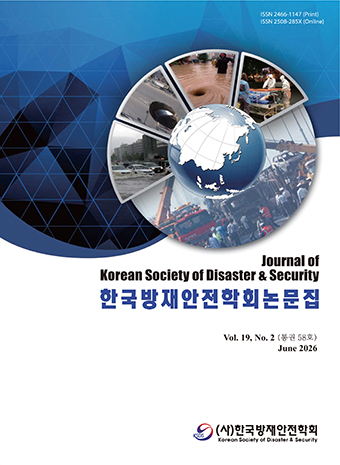
  • Journal Title :Journal of Korean Society of Disaster and Security

  • Journal Title(Ko) :한국방재안전학회 논문집
  • Volume : 13
  • No :4
  • Pages :47-63
  • Received Date : 2020-10-05
  • Revised Date : 2020-10-29
  • Accepted Date : 2020-12-01